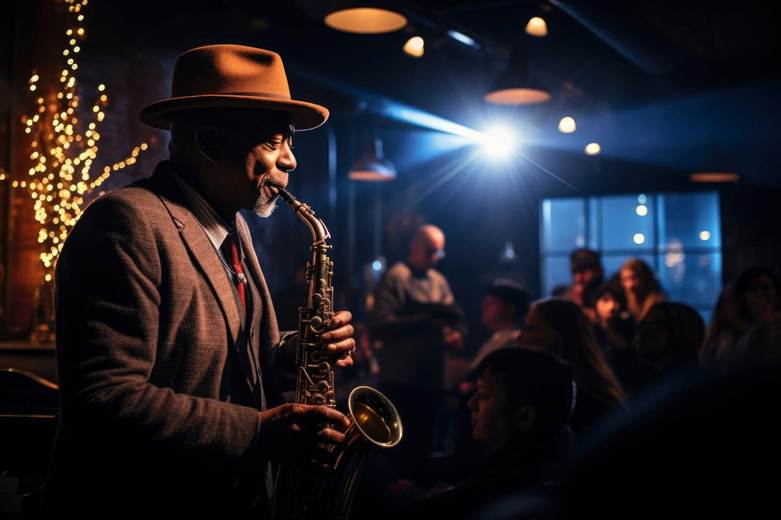
Occasionally the distance between a musician and the audience is only a few feet. Sam Coquillard points to that physical closeness as one reason a small jazz club can create an experience that a large concert venue cannot easily replicate.
Both settings can produce memorable music, but they ask different things of the listener. A large venue can create spectacle, scale, and collective energy. A small jazz room often turns attention toward details: a drummer changing the texture of a rhythm, a pianist leaving unexpected space, or musicians exchanging subtle cues before changing direction.
The room becomes part of how the music is experienced.
Distance Changes What the Audience Notices
In a large venue, the stage can feel separate from the audience.
Lighting, amplification, screens, and production help bridge that distance. The result can be powerful, particularly when thousands of people react together.
A small jazz club removes much of that separation.
Listeners may be close enough to watch a bassist’s hands move across the instrument or notice a drummer preparing to change patterns. A glance between musicians becomes visible. So does the concentration required during a difficult passage.
These details do not necessarily change the notes being played.
They change how the audience receives them.
Instead of observing a performance from a distance, listeners can feel as though they are sitting close to the musical process itself.
Quiet Music Has More Room to Matter
Not every memorable musical moment needs to be loud.
Small jazz rooms can make quiet passages unusually compelling because listeners are close enough to hear details that might be less noticeable in a larger environment.
A lightly played cymbal can become significant. A soft piano phrase does not need to compete with the scale of a large room. A bassist can reduce intensity without disappearing from the audience’s attention.
This allows musicians to work with a broader range of dynamics.
Volume becomes expressive rather than simply practical.
A group can build intensity gradually and then pull back, trusting that the audience is close enough to follow the change.
The Audience Becomes More Aware of Its Own Sound
Intimacy is mutual.
If listeners can hear the musicians more clearly, musicians can also hear the room more clearly.
A conversation at a nearby table, a ringing phone, or the sound of someone moving through the space can become more noticeable during a quiet passage.
That can create a different kind of audience etiquette.
People begin recognizing that attentive listening contributes to the environment. Silence is not simply the absence of audience participation. It gives the music room to develop.
Applause also feels different in a smaller space.
A strong response after a solo can immediately change the energy in the room, given the limited distance between performers and listeners.
The audience is not performing with the band, but its presence is difficult to ignore.
Musicians’ Communication Becomes Visible
Jazz depends heavily on interaction.
In an intimate venue, some of that interaction can be seen as well as heard.
A musician may nod toward another player before passing over a solo. A drummer might watch the soloist closely while changing dynamics. Someone may smile after an unexpected musical idea, revealing that the moment surprised the performers too.
From farther away, these gestures may disappear into the overall performance.
Up close, they help listeners understand that jazz is being shaped in real time.
The musicians are not simply executing independent parts according to a fixed sequence.
They are paying attention to one another.
Watching that process can make even a familiar composition feel unpredictable.
Imperfections Can Make the Performance More Human
Large productions can create extraordinary levels of polish.
Small clubs often offer another kind of appeal.
Listeners may hear the physical details surrounding the music: the sound of fingers moving on strings, a musician taking a breath, or a brief adjustment before the next piece begins.
Not every moment needs to feel perfectly packaged.
That closeness can remind the audience that people are making decisions in real time as they create the music.
Improvised music fits that environment particularly well because uncertainty is part of the experience. People are making decisions in real time as they create the music
An unexpected phrase can redirect a solo. A transition may happen differently than anticipated. A musical idea can emerge and disappear within seconds.
Those moments are not interruptions to the performance.
They are part of what makes live jazz live.
The Room Can Influence the Music
A venue is more than a container for sound.
Its size, shape, materials, stage placement, and audience arrangement can affect how a performance feels.
A small room may encourage musicians to play at lower volumes because amplification does not need to reach thousands of people. Instruments can feel physically present rather than distant.
The arrangement of the audience also matters.
Tables positioned close to the stage create a different atmosphere from rows of seats stretching far into an auditorium.
Musicians are performing in a room they can see.
That can make the exchange between stage and audience feel more immediate.
A Small Club Encourages Focus
Large concerts contain many sources of stimulation.
The crowd itself becomes part of the event. There may be elaborate lighting, visual production, large screens, and significant movement throughout the venue.
A small jazz club can strip much of that away.
There may be little to watch besides the musicians.
That simplicity encourages a different type of attention.
Listeners can follow how a solo develops rather than waiting only for its most dramatic moment. They can notice the rhythm section changing beneath it. They can hear how one piece transitions into another.
The experience rewards concentration.
For someone accustomed to hearing music while driving, working, exercising, or doing something else, sitting in a room designed primarily for listening can feel surprisingly different.
Familiar Songs Can Become More Personal
Jazz musicians frequently perform compositions that audiences may already know.
A smaller venue can change the relationship with that familiar material.
Hearing a recognizable melody from only a short distance away can make it feel less like a reproduction of a recording and more like a unique event.
The arrangement might differ. The solo order could change. The tempo may be altered. Musicians can extend one section because the performance is moving in an engaging direction.
The listener knows the underlying song but does not necessarily know how this version will unfold.
That combination of recognition and uncertainty is one of the pleasures of live jazz.
Seating Can Change the Experience
In a large venue, seat selection often revolves around distance from the stage and overall sightlines.
A small club introduces different considerations.
A seat close to the drummer may reveal rhythmic details more clearly. Sitting near the piano can make subtle accompaniment easier to notice. Another position might provide a better view of how the full group communicates.
There may not be one objectively best seat.
Different locations emphasize different parts of the performance.
That can make returning to the same venue worthwhile. The room may be familiar, but hearing the band from another position can shift what stands out.
Small and Large Venues Offer Different Strengths
Appreciating intimate jazz clubs does not require dismissing larger venues.
A concert hall can provide excellent acoustics, ambitious programming, and the excitement of experiencing music with a large audience. Festivals can bring together musicians who might rarely appear on the same program.
Small clubs simply offer another relationship with live music.
Their strength is proximity.
The audience can observe the mechanics of collaboration, hear quieter details, and experience the reactions moving between musicians and listeners.
The performance feels less distant because it is physically closer.
Sometimes the Room Becomes Part of the Memory
People often remember live music through individual songs or solos.
They may also remember the setting.
The small table, the close stage, the moment the room became completely quiet, or the reaction after an unexpected solo can become inseparable from the music itself.
That is what an intimate jazz venue can offer.
It reduces the physical space between performer and listener, making small musical choices easier to notice and spontaneous interactions harder to miss.
A recording lets you hear a remarkable performance again and again. A large venue can turn music into a shared event on an impressive scale.
A small jazz club offers something different: the sense that the audience was close enough to watch a particular performance take shape, one decision at a time.